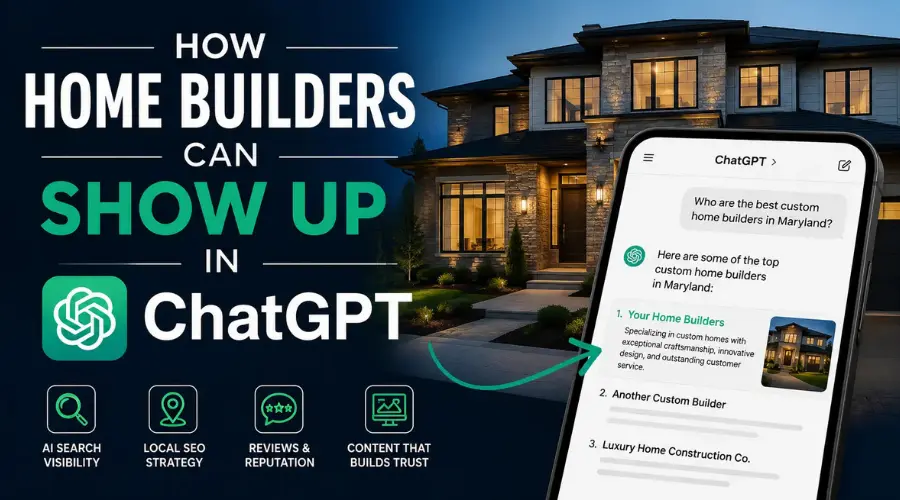
Homebuyers are increasingly turning to AI for high-stakes decisions, asking questions like “custom home builders Miami 2026,” “luxury home build costs Florida,” or “how long does it take to build a 4,000 sq ft custom home.” When ChatGPT answers these queries, it does not promote builders who flip spec homes or rely on thin marketing pages. It prioritizes custom home builders with proven large-scale portfolios, realistic timelines, transparent costs, and strong authority signals across the web.
This article adapts the GEO strategies from our kitchen remodeler and general remodeling discussions and refines them specifically for custom home builders. Custom homes are high-ticket, long-duration projects, and AI systems favor builders who document that complexity clearly and credibly.
Why Custom Home Builders Are Evaluated Differently by AI
Custom home searches are fundamentally different from remodeling queries. Users are not looking for speed or discounts. They want confidence. AI models respond by surfacing builders who demonstrate experience with complex projects, permitting, engineering coordination, and long timelines.
ChatGPT is far more likely to recommend a builder who shows multiple $800K to $2M builds with documented phases than one who lists “custom homes” as a service without proof. Depth, realism, and data matter more than volume.
The Custom Home Builder GEO Roadmap
To rank in ChatGPT results, custom home builders must position their brand as a local authority on cost, process, and execution. This starts with a strong technical foundation and expands into high-quality, data-rich content and third-party validation.
Technical Foundation for Custom Home GEO
ChatGPT relies heavily on Bing for local business discovery, making Bing Webmaster Tools a required starting point. Submit your website, verify ownership, and ensure your XML sitemap is clean and regularly updated when you publish new projects or guides.
Your robots.txt file should allow GPTBot and Bingbot to crawl all public pages. Implement HomeAndConstructionBusiness schema markup that clearly defines your business type and specialties, such as modern waterfront homes, sustainable builds, hurricane-resistant construction, or luxury teardown rebuilds. Schema clarity helps AI understand exactly what kind of builder you are and which queries you should appear for.
Interactive tools strengthen this foundation. A “Custom Home Cost Estimator: Miami 2026 Edition” that explains ranges, not promises, increases user trust and gives AI structured information to summarize.
Hero Content That AI Considers Authoritative
Custom home builders win AI visibility by publishing fewer pages with much greater depth. One comprehensive guide often outperforms dozens of thin service pages.
A flagship page like “Building a Custom Miami Home 2026: $500K–$2M Breakdown” should walk readers through the entire process. Include sections on land acquisition assumptions, architectural design costs, permitting timelines, construction phases, and finish-level pricing. AI models favor this type of end-to-end clarity because it answers multiple user questions in one place.
Use natural-language headers that reflect how people ask AI questions. Examples include “How long does it take to build a custom 4,000 sq ft home?” or “What permits are required for a custom home in Miami?” Break answers into phases such as design, permitting, foundation, framing, and finishes. This phased structure aligns perfectly with how ChatGPT summarizes complex processes.
Case Studies That Prove Large-Scale Capability
For custom home builders, case studies are more important than generic galleries. Each project page should read like a documented build, not a highlight reel.
Include the location, total square footage, approximate budget range, and full timeline. Explain challenges such as coastal permitting, hurricane code requirements, or utility coordination. Visuals should include progress shots, not just finished exteriors. Framing photos, slab pours, and interior rough-ins signal real construction experience.
360-degree virtual tours or deeply detailed breakdowns, such as “Bridgewater Teardown-to-Luxury: 18-Month Timeline,” give AI tangible proof that you manage complex builds. Metrics like “permit approval in 92 days” or “completed within 3 percent of original budget” are especially powerful authority signals.
Local Permitting and Cost Transparency as Trust Signals
AI models are cautious with high-cost recommendations. Builders who avoid discussing permits, timelines, or costs are often excluded from ChatGPT responses.
Custom home builders should openly discuss local permitting realities. Explaining that Miami permits may average 90 days or more, depending on zoning and coastal overlays, demonstrates honesty and expertise. Including realistic cost bands rather than exact pricing builds credibility without overcommitting.
Updating these pages with visible timestamps such as “Updated February 2026” reinforces freshness and relevance, increasing the likelihood that ChatGPT pulls your data instead of a competitor’s.
Platform and Ecosystem Leverage for Builders
AI cross-checks your website against third-party platforms to validate reputation and scale.
Google Business Profile remains foundational. Builders with 4.8-plus star averages and over 100 reviews are far more likely to appear in “near me” and city-based AI recommendations. Pin recent groundbreakings, framing milestones, and completed homes to show active, ongoing work.
Houzz and its design-focused audience are particularly influential for luxury custom homes. Upload 30 or more high-end projects with detailed specs such as square footage, estimated budget range, and design style. Houzz combines visuals, reviews, and professional context, making it a strong AI authority source.
Reddit adds experiential validation. Hosting AMAs in r/Homebuilding or r/CustomHomes, such as “AMA: Built 50+ Miami Custom Homes—Ask Me About Costs and Timelines,” creates authentic discussions that AI models often reference. These threads demonstrate real expertise rather than marketing claims.
LinkedIn supports authority for upscale and B2B-oriented leads. Sharing permitting wins, architect collaborations, and engineering milestones under a consistent brand profile reinforces professionalism and trust.
Acceleration Tactics That Compound Results
Some GEO actions produce faster gains when executed consistently.
A structured review playbook can significantly boost AI visibility. After project completion, prompt clients to share their custom home journey on Google, encouraging mentions of staying on budget, communication quality, and timeline management. Reviews that include photos of framing or finished exteriors are especially valuable.
Unique content hooks also accelerate authority. Monthly posts like “2026 Custom Build Trends: Hurricane-Proof Designs” with original data points, such as average permit durations or material performance stats, differentiate your brand from generic builders.
Tie Reddit discussions directly to your site case studies. When third-party conversations link back to documented projects, you create a reinforcing loop that strengthens E-E-A-T signals across platforms.
Measuring Impact and Refining Strategy
Regularly test by asking ChatGPT queries such as “top custom home builders Miami under $1M.” Note which builders appear and analyze their review volume, portfolio depth, and content structure. Use these insights to refine your own pages rather than copying tactics blindly.
Monitor crawl activity and impressions in Bing Webmaster Tools to confirm that new content is being indexed. Most builders see baseline eligibility within two to four weeks, with compounding visibility gains appearing in six to eight weeks when execution is consistent.
Final Takeaway for Custom Home Builders
Ranking in ChatGPT results as a custom home builder is about demonstrating competence at scale. AI favors builders who show realistic timelines, transparent costs, deep portfolios, and strong third-party validation.
By combining a solid Bing-first technical setup, comprehensive cost and permitting guides, detailed case studies, and authentic community engagement through platforms like Google Business Profile, Houzz, Reddit, and LinkedIn, custom home builders can position themselves as the obvious authority in their market.
In 2026, the builders who document best are the builders AI trusts. When that trust is earned, ChatGPT becomes a powerful referral engine for high-intent, high-value custom home clients.
Related Posts